Thursday, July 6, 2017

WSC 2017 Update: July 6th

This is going to be a really brief update because I'm really busy, but the teams list has been released! Here's a reeeaally quick rundown of the teams, with some short notes on some of them:

Challenger Class

2: University of Michigan: Novum

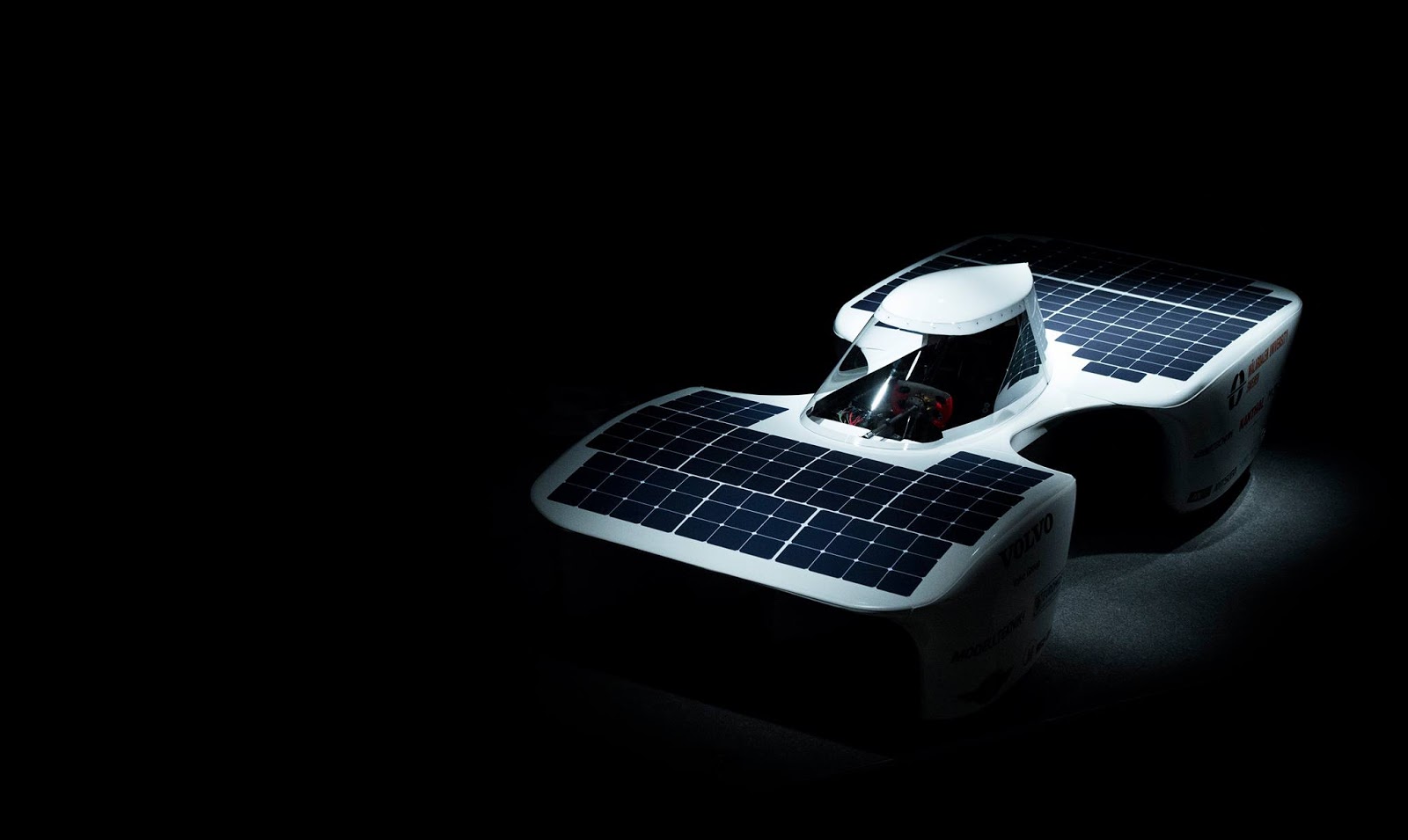
Michigan is unveiling their car tomorrow! I've heard through the grapevine that Michigan is using a 2.64sqm multijunction gallium-arsenide solar array, rather than the 4sqm silicon array most teams are using. 

2011-2015, very few teams tried a GaAs array, as teams were only allowed 3sqm of it, vs 6sqm of Silicon. Since WSC is allowing (proportionally) more GaAs this year, it's a much more attractive option - and I'm a little surprised that I haven't seen more cars trying it.

Expect Novum to look quite different than the rest of the field.

3: Nuon: Nuna9

Nuon has hinted that they may have made some big changes to the layout of the car. I wonder if they are doing a GaAs array, like Michigan?

4: Antakari: Intikallpa IV


6: MIT: Flux


7: Adelaide University: Lumen II


8: Punch Powetrain: Punch Two


10: Tokai University: Tokai Challenger (2017)

Name your car something new please, at least put a number behind it! This is at least the 5th "Tokai Challenger".

12: Cambridge University Eco Racing: (no car name provided)

CUER is fielding a little bullet car again, just like in 2013 and 2015. They're also going to be trying a tracking array again, like the 2013 car (but unlike 2015). As described above in the Michigan section, since the proportion of allowed GaAs to Silicon has gone up significantly for 2017, CUER's concept may have a chance of being actually competitive this year - although CUER will need to make sure the car is reliable enough to finish the race. They only managed to finish 2/3rds of it last time around...

13: Polytech Solar: SOL

This is a new team from Russia - we've written a little about them before.

15: Western Sydney University: (no car name provided)

Initially, there was a rendering of WSU's car on the teams list, but that has been removed. I guess it wasn't supposed to be released yet, whoops! It was an asymmetric catamaran, with a very thin array airfoil that was overhanging the fairings by a very long distance forward.

16: Stanford: Sundae


18: UiTM Eco Photon: TUAH


20: Durham: DUSC


21: Twente: RED Shift


22: MDH Solar Team: MDH Solar Car

This can't be the real name of their car, right?

23: University of Tehran: Persian Gazelle IV


25: NIT: Horizon ZZ


26: Missouri S&T: Solar Miner

As far as I know, this team withdrew from WSC 2017 two weeks ago and their WSC team profile contains no information, so I'm not sure why WSC included them on the teams list.

28: Neul-Hae-Rang: Woong-bi

This is a brand new team from the Korea National University of Transportation

29: STC-2 Edison: Edison

This is the Challenger entry from Siam Tech

32: Principia College: Ra X


33: Cairo University: Horus

This is a new team from Egypt. They're listed as a Challenger class, but the car rendering on the WSC teams page sure looks like a 2-seat Cruiser class car...

34: RVCE: Arka


37: Goko High School: Musoushin (2017)

I really don't understand why Japanese teams insist on giving the car the same name every year. How are you supposed to distinguish between them when talking??? Also, from their WSC team profile:

"What is unique about your solar car? We brought out the flavor of the materials." I hope this is literally what they wanted to say rather than a translation error, because that's an amazing answer.

"What is the one thing your team is looking forward to when you visit Australia? We are looking forward to eat a big steak at everynight!" A team after my own heart.

38: NWU: Naledi

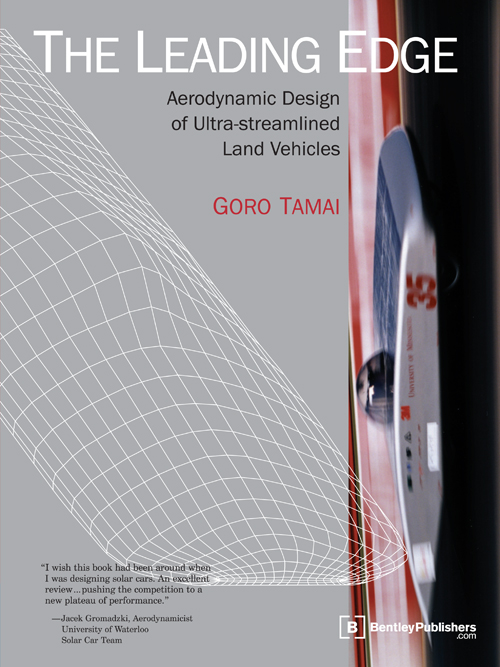
The rendering on the teams page shows a narrow bullet car with outrigger wheels and a small "wing" solar array aft of the driver compartment. It looks very early-90s-solar-car - a style of solar car design that faded away rapidly as it became apparent that more-integrated designs were superior. We'll see if this is a good design strategy with the benefit of modern materials and the new smaller arrays.

Party like it's 1987!
(image source)

39: Estidamah: (no car name provided)

This is a new team from Saudi Arabia, with zero information on their team page on the WSC website. Twitter here: https://twitter.com/estidamah

43: Sol Invictus: Sol Invictus

This is a new team from the Australia National University

46: JU Solar Team: Solveig


70: Team Sonnenwagen Aachen: HUAWEI Sonnenwagen

I guess selling the naming rights to the car is one way to raise money, but... ugh.

71: ITU: B.O.W. ISTANBUL


72: Proton: Noor

This is a new team from Sudan. Facebook here: https://www.facebook.com/MeiProtonSolarCar/

77: Blue Sky: Back in Azure

I'm a little confused by the listed car name. The team's 2011 WSC car was named Azure, are they bringing an old car back???

82: KUST: Baek Ho2


88: Kogakuin: Wing


Cruiser Class

5: SunSPEC: SunSPEC5


9: PrISUm: Penumbra


11: HS Bochum: Thyssenkrupp Blue.Cruiser


14: Flinders: Investigator Mk III


23: University of Tehran: Persian Gazelle IV


30: Clenergy Team Arrow: (no car name provided)


35: IVE: Sophie VI


40: Eindhoven: Stella Vie

It's not exactly news about the car, but a great article about how solar cells work was recently published by someone associated with the team.

42: TAFE SA: SAV


45: Lodz: Eagle Two


49: STC-2 Nikola: Nikola

This is the Cruiser entry from Siam Tech.

66: Creatti Solar Car Team: CrossVan

This is a new team from Columbia. Facebook here: https://en-gb.facebook.com/creattisolarcarteam/

75: UNSW Sunswift: Violet


94: University of Minnesota: Eos II


95: Apollo: Apollo VIII


Adventure Class

51: Illini Solar Car: Argo

This is a new team from the University of Illinois at Urbana-Champaign, they're also aiming to enter ASC with this car in 2018.

53: Mississippi Choctaw High School: Tushka Hashi III


Missing Teams

The following WSC 2015 teams won't be returning:

  • Challenger teams: EAFIT, UKZN, Solaris, MegaLux, Anadolu, KIT, and Bejing.
  • Cruiser Teams: ITS and Ardingly.
Some of these I already knew about and others I sort of expected, but MegaLux is a bit of an unwelcome surprise - they did great for a rookie team in 2015 and I had high hopes for them this year :(

Also missing from the list is Onda Solare, which has attended WSC in the past and was rumored to be entering the Cruiser class this year.

Monday, July 3, 2017

Quick Links: July 3rd, 2017

Some quick news from the past few days:

WSC has officially-officially announced what was posted on Facebook a few days ago: the official teams list is coming out on Thursday, July 6th. That said, ahead of the announcement, we've heard that EAFIT, UKZN, and Solaris are definitely not going to be returning to WSC in 2017. Too bad :(

We've also heard that Goko High School will be returning, and has already completed their car. A reader sent us this photo:


It looks almost exactly as one would expect Goko's 2015 WSC car to look if it were remixed into an asymmetric catamaran. The school certainly has a distinctive style/design language... Given that the rear wheel is in the same sort of pod as the front wheel, I wonder if it has 4-wheel steering? Also of note: It's only 9 solar cells across, whereas the 2015 solar cars were generally wide enough to fit 13 solar cells across. This puts the car in the ~1.3m wide range, which is very narrow (nine 125mm square Sunpower cells would be 1.125m wide with no gaps between them).

TAFE SA also appears to be working on a new car, if their Facebook page is any indication - I missed them in the big June 29th post.

IVE officially unveiled Sophie VI - there are some good photos on their Instagram here and here. The second photo in particular shows exactly how tiny the side windows are - I feel like driving this car will feel like driving from inside an armored bunker. The car is visibly a huge step up in quality from the 2015 car, hopefully that is reflected in the car's performance as well.

Stanford also unveiled their car over the weekend. It's pink!

Pink!
(image source)
You can see how the driver is set very far back with basically zero rear overhang of the array behind the fairings, and a moderate front overhang. The rear of the car also narrows quite a bit, although there's still a pretty sharp edge from the edge of the array to the vertical side of the car:


Overall the car feels similar in proportions (length to width) to the 2015 WSC cars, just smaller. Speaking of the size, the team also had their old car Arctan on display nearby - you really get a sense of how tiny the new cars with 4sqm arrays are:

smol car and big brother
(image source)
I was there for the unveiling, and managed to snag this photo of the tunnel - this isn't a simple flat underside, there's some special contouring going on under here. Also, I think the non-driver-side fairing is smaller than the driver fairing, in both width and length. Note how the leading edge fairing on the left of the photo is further forward than the one on the right for the photo?

Sundae tunnel
Image source: MostDece CC BY-NC-SA 4.0

Finally, all 18 teams showed up bright and early in the morning for the start of FSGP inspection in Texas today, and things seems to be going well. Inspection will wrap up on Wednesday, and then teams will spend 3 days racing on the circuit. Of note, Principia has their new WSC 2017 car Ra X at the track. It's sans-array right now - the team says they have another upper with complete solar array finished already, but didn't want to risk accidental damage here at the track. I think they'll just be running as a demonstration vehicle at FSGP and charging off the wall every night.

Image source: MostDece CC BY-NC-SA 4.0
Note the edge of the top array area - rather than blending around straight into the side of the fairing, it bulges outward a bit.

Image source: MostDece CC BY-NC-SA 4.0
Like Stanford's car, it's a little shocking how tiny the car is in person - 4sqm is not a lot of array. Ra X is very rectangular in planform, and feels "stubby", for lack of a better word - it's proportionally wider/shorter than the cars of two years ago. It has almost no overhang in front of the fairings, and very little overhang behind.

That's it for now - I'll see you all when the teams list is published in two days


Friday, June 30, 2017

Quick links: June 30th, 2017

Oh man everyone, you're in for a treat: TWO MOSTDECE POSTS IN TWO DAYS! Since there's no official teams list yet, I missed a few things - and as this is car reveal season, things are moving quickly.

On the topic of the teams list, someone on Facebook has seemingly-definitively announced that the official team list will be announced on July 6th, 1300 Adelaide time - so sit tight for another week

Of possible interest to our German readers, Nigel pointed out perpetu-blog, which has some articles on WSC.

On the team front, there's one team that I missed that is showing significant progress: Polytech Solar Team, from St. Petersburg Polytechnic University in Russia. Not much to see on their Twitter and even less on Facebook, but a TON of photos on VK. They're deep into the construction of an asymmetric catamaran, with the sides of the array nicely blended into the catamaran fairings - very similar to Punch's car this year. Looks like they'll be doing leading arm suspension up front, based on the shape of the chassis.

KUAS unveiled Apollo VIII yesterday, and it is indeed a catamaran/tunnel style Cruiser that is similar in concept to Kogakuin's car last year, although not quiet as elegant. I'm pretty sure it's a two-seater.

Apollo VIII
(image source)

There's a video of it driving around on Facebook. The window attachment looks a little dodgy, but there's plenty of time between now and the race to fix that. Also, DANG that window tint is deep - that's gotta be breaking reg 2.17.3, right?

IVE's unveiling event isn't supposed to be until July 2nd, but a photo of it has snuck out early in a news article:

Sophie VI

It looks like the car has a lot better fit & finish than Sophie V did last time around. Notable in the news article, a claimed 300kg weight (not bad for a two-seat solar car), and magnesium alloy suspension.

Finally, it appears that Siam Tech *is* actually working on a car, it's just that their social media accounts have changed a little and I didn't find them before... their current website claims that they are building both a Challenger and a Cruiser car! The Challenger Edison is illustrated as fairly generic asymmetric catamaran, whereas the Cruiser Nikola is... literally a traced-over copy of Bochum's 2015 car.

Edison
Nikola
(totally not traced over a photo of Bochum's SunRiser, we swear)
OH HAI

And neither of those illustrations match the car that they're currently building on Facebook. So, who knows?

In the near future, Stanford is unveiling July 1st (today!), IVE (officialy) on the 2nd, Bochum on the 5th (although we already have renders), Michigan on the 7th, Minnesota on the 11th, and Nuon is unveiling on the 25th. Principia should also be unveiling really soon - the car is all done, but this is the only photo they've posted so far... They're bringing it to Formula Sun in Texas for a shakedown race before WSC in the fall, and scrutineering for that race starts on Monday!

Finally, maybe it's the beer talking, but let's close out this post with a moment of zen from the App State team as they pack up for FSPG.


Thursday, June 29, 2017

WSC 2017 Update: June 29th

It's the post you've all been waiting for: The first MostDece team update post of the WSC 2017 season! I'd been postponing this update until the official entry list is released, which I was told was supposed to happen on World Environment Day (June 5th) or the Solstice (June 20th), but those dates came and went... and teams are starting to unveil cars. I've heard word that WSC may be releasing the teams list today-ish, as part of this #100days campaign that they seem to be coordinating on social media with teams? We'll see.

Scientific Gems has a pretty good teams list. You should check it out.

Alright. First let's run down the list of teams from last year, and then look at other teams that appear active on social media:

Challenger Class: Returning WSC 2015 Teams


University of Michigan

Michigan is a regular competitor at WSC (they first competed at WSC in 1990!), and finished 4th in 2015. They've finished 3rd place at WSC on five separate occasion (1990, 2001, 2005, 2009, and 2011), but never higher than that. Most recently, the team came in 1st at ASC in 2016 (for the sixth straight time, no less). Their finish at ASC is all the more impressive because of heavy cloud cover and rain along the entire route, and Michigan were the only team to finish entirely on solar power.

About a month ago, they announced that the new car will be named Novum, and there's a lot of car-construction evidence on social media. I believe that they're going to unveil the car on July 7th.

The returning champs of WSC 2015 have won the race six times, and finished in 2nd on two other occasions - never finishing lower than that as WSC. Recently they also won the Sasol Solar Challenge in the fall of 2016, and are definitely coming back to WSC in 2017. They've posted a little about doing test flat-panel layups, but like Michigan, Nuon is traditionally pretty secretive about their design. Expect that we won't see much from Nuon until the car is complete.

That said, Nuon has already revealed that they're using Mitsuba's new sliding stator motor. Mitsuba has been working on this motor since 2006 and Kei Nomura is understandably excited.

The team is planning on revealing the car on July 25th, and they say they have some surprises for us!

Antakari Solar Team

Antakari ended up withdrawing from WSC 2015 before the event, but it looks like they're hard at work building a fresh car for 2017. There are lots of photos of composite work on their facebook account; it looks like they're building an asymmetric catamaran. I don't think I've seen a photo of the bottom mold yet, so I'm not sure what the fairing layout looks like.

App State (a relatively new team from the USA) claims to be sending some members to join them for WSC.

EAFIT finished 13th at their first WSC in 2013, and 9th in 2015. Their website claims they are shooting for a top-5 finish in 2017.

Previously the team was named EPM-EAFIT, but the team appears to have split from their partnership with EPM.

There's not a lot of action on their social media accounts, and no photos of car parts under construction.

MIT Solar Electric Vehicle Team

MIT finished the 2015 WSC in 23rd place, with 1835km of 3022km complete. They have announced their intent to compete in WSC 2017, with a new car named Flux. They appeared to be on a very aggressive construction schedule, completing the body layups for an asymmetric catamaran in November of 2016! Notably, it appears to have split non-driver-side fairings; a feature that very few asymmetric catamarans had in 2015 (12). However, they haven't posted any updates at all since doing their body layups.

Punch Powertrain Solar Team

Punch finished 5th at WSC in 2015, and will definitely be back for 2017. They recently unveiled their new car Punch II.

Punch II unveiled on June 22nd
(image source)

One of the things I've been really interested to see is how Challenger teams shape their cars, now that the array area is so much smaller than the possible planview area and teams are no longer forced to build The Rectangle. Will they go long and narrow? Short and wide? Some sort of radically rounded shape?

Punch has definitely taken advantage of the new rules - rather than being rectangular, the car is narrower at the nose and tail, and the edges of the main airfoil are rounded significantly. I really like how they've blended the front corners of the mainfoil into the wheel fairings. It's a little hard to tell, but the car looks proportionally a little shorter/wider than the Challenger cars last year.

Adelaide University Solar Racing Team

AUSRT was a new team for 2015, finishing WSC in 21st with 2292km of 3022km completed. They have announced a new car for WSC 2017, Lumen II, as well as a goal of a top-10 finish.

There's been a lot of composites layup photos on Twitter, it looks like it'll be a pretty typical asymmetric catamaran.

Tokai University Solar Car Team

Tokai has been a consistent top performer at WSC over the past several races, finishing 1st in 2009 and 2011,  2nd in 2013,  and 3rd in 2015. They also recently finished 2nd (behind Nuon) at the 2016 Sasol Solar Challenge. I presume they're planning on attending WSC in 2017? Although I can't find any definitive announcement or photos of the new-car-in-progress, they've been re-tweeting and sharing other teams' announcements on Twitter and Facebook. Tokai is usually pretty quiet on social media so lack of an announcement or car progress photos is normal, and I'd be surprised if they weren't going to fight to get the trophy back from Nuon.

Cambridge University Eco Racing

CUER finished WSC 2015 in 22nd place, with 2047km of 3022km complete. They're definitely planning to attend WSC 2017, but haven't dropped any details about their design yet. It sounds like they started constructing the new car in early May.

WSU Solar Car Project

Western Sydney finished 11th at their first WSC in 2013, and 10th in 2015 - which is more impressive than it sounds, as only 10 cars finished the entire distance in 2013, whereas 20 cars finished in 2015.

WSU is definitely planning to come back to WSC in 2017. They've recently released a great documentary about their 2015 race, and their May Newsletter shows off some photos of car construction. They're keeping details of the design pretty close to their chests, though...

UKZN Solar Car

After coming in 13th at their first WSC in 2015, things have been pretty quiet from this team. They chose not to attend the 2016 Sasol Solar Challenge in their native South Africa, which they first attended in 2012, and finished 3rd in 2014. Choosing not to race at an event in their home country because the team is "exhausted" from a race the prior year is a little odd, as is the statement that members need to focus on postgraduate work... a team needs to be continually recruiting and training younger students to replace those who graduate. Teams that are built around a few strong personalities rather than an institutional tradition often fade away rapidly after a few strong race cycles, and I wonder if that's what we're seeing here.

So far I've seen no public indications that UKZN in planning on WSC 2017.

Team Solaris

Team Solaris finished WSC 2015 in 25th, with 1575km of 3022km complete. More recently, they came in 3rd at the Moroccan Solar Race Challenge 2016, and tried to attend the Egyptian Solar Challenge in March but never managed to get their car through customs (not an uncommon problem at that event). No word on whether they're planning for WSC 2017.

(Aside: I've found it impossible to find out what happened at the Moroccan solar challenge, I can't even find an official set of results, much less a teams list. All I know other than Solaris in 3rd is that Onda Solare won the event with their WSC 2013 car)

Stanford Solar Car Project

Stanford has been putting on a strong showing in the past few years, coming in 4th place in 2013 and 6th place in 2015. A quick glance at their social media shows that they're definitely planning on WSC 2017 and are nearly ready to unveil their new car, which they have named Sundae. I like the rendering that shows how much smaller their new car is that the ones built under the old regs.

NWU Solar Car

NWU put in a strong 11th place finish at their first WSC in 2015, and recently finished 4th at the 2016 Sasol Solar Challenge (the same position they finished in 2014).

The front page on their website states that they are planning to attend WSC 2017 with a brand new car, and there are a lot of posts about constructing it on their social media. Of particular note, they're molding their own carbon fiber rims. While really cool, I'm wondering how well they'll hold up... GHCraft is the gold standard of carbon solar car rims nowadays, but OG solar car folks will remember that it took them 2-3 revisions to get in right; the first rev in that was in use around '03 was particularly prone to failure in cornering...

EcoPhoton Solar Team

The team from Malaysia has declared their intent to attend WSC 2017 all over their website, Instagram, and Twitter. It appears that they did their bottom shell layups over the first week of February, and composites photos continue to be posted to Instagram (123).

Solar Team Twente

Twente is a team that's been on the rise over the past few years: a 5th place finish at WSC 2011, 3rd place in 2013, and a nail-biting 2nd place finish at WSC in 2015. They also won the 2016 European Solar Challenge this past September. The team has already unveiled their new car Red Shift - it's a great looking car, and I expect that the team will continue their streak in the top-5 at WSC

Red Shift and The Stig?
(image source)

That said...  I wrote two years ago that it was notable how much Red One stood out from the crowd of identical cars, whereas this year my first impression of their car is "it looks like Twente copied Nuon's homework". Given how the rules changed and blew the aerodynamic design space wide open, I'll be a little surprised (and disappointed) if the winning car looks just like the previous winner at 2/3rds scale.

Siam Technology College

Siam Tech is from Thailand, and was a brand new team at WSC 2015. They were unable to complete dynamic scrutineering, and did not start the race. Absolutely nothing has been posted on their social media accounts since they walked the car across the finish line in Adelaide. I do not expect to see them in 2017.

MegaLux GAMF

MegaLux was a brand new team at WSC 2015, putting in a very strong 7th place finish. They also took the 3rd place finish at the 2016 Sasol Solar Challenge in October. 

They announced at the start of March that they are constructing a new car for WSC 2017.

Goko High School Solar Car Team

Goko finished 14th at the 2015 WSC, which is extremely impressive for a high school team. I couldn't ever find any team presence on the internet back then, so I have no idea what they're up to nowadays - but they *are* one of the teams that Bridgestone announced they would be supplying tires to, so presumably they're planning on attending.

Durham University Solar Car

Durham had a rough time at WSC in 2017; they had electrical issues during dynamic scrutineering and completed precisely zero kilometers of the 3022km challenge. However, it sounds like they're determined to give the challenge another shot. The team posted a video of their solar car driving in May, with a caption that implies this is the car that they're bringing to Australia - but it appears to be their 2015 car? I wonder if they're just planning on stripping 2sqm of solar cells off the top instead of building a whole new car.

RVCE Solar Car Team

This team from India was unable to compete in WSC 2015 - they had shipping issues with the car, which did not arrive until after scrutineering was nearly completed. It certainly didn't help that the car was perhaps 75% complete, at best.

They have been extremely active on social media and their blog and they appear to be building a new car for 2017 - although pictures of progress are worryingly non-existent at this point.

Team Arrow

Team Arrow finished in 8th place in 2015. They've announced that they're switching to the Cruiser Class for 2017 and that the car will be commercially available (in limited numbers). Bold! I'll be suitably impressed if they can follow through on that. They haven't unveiled the car yet, but the renderings they have posted are very reminiscent of UNSW's eVe from 2013 and 2015 - a low slung, two-seat "sports car" appearance. I'll take one in orange, please!

Principia Solar Car

Principia finished in 17th at WSC in 2015, as well as 5th place at the American Solar Challenge in both 2014 and 2016. They've built a new car for WSC 2017, although they haven't unveiled it yet. They must be doing that soon, since they've entered it into FSGP 2017 -which starts in a week!

Of note, they also have the sweet new Mitsuba motor with the variable field sliding stator version of this motor, along with Nuon and JU.

Anadolu Solar Team

Anadolu finished 19th at WSC 2015. Last year, they participated in the 2016 Salsol Solar Challenge with a brand new car Sunatolia 3. In March, they posted a photo of it tagged with #bwsc17, so it sounds like they're ready with a fresh car and planning to show up. They'll have to strip 2sqm of array off that car to meet the new 2017 regs, though.

JU Solar Team

The JU Solar Team was a new team in 2013, when they DNF'd. They came back to the next WSC, finishing 15th in 2015, and they're going to be coming back for 2017. There's some signs of construction on social media, and they're the third team that I know of that has one of the new sliding stator Mitsuba motors.

Nagoya Institute of Technology Solar Car Team

NIT came in 16th at their first WSC in 2015. They're currently racing their car at Suzuka, and it appears that they're building a new car for WSC 2017. They're also one of the teams that Bridgestone is supplying with tires.

KIT Solar Car Project

KIT finished WSC 2015 in 18th place. They're currently racing that car at Suzuka, with a very strange new canopy/windshield (12). I'm not sure if they're planning on WSC 2017.

Edit 7/2: A reader has pointed out that both KIT and Nagoya were doing a practice lap day at Suzuka, and the race itself is in August. Whoops - I know the Dream Cup is always run in August - this is what I screw up when I write these too late into the night... 

Blue Sky Solar Racing

Blue Sky finished in 12th at WSC 2015. It looks like they're working hard on a new car for WSC 2017.

Beijing Institute of Technology

The team from China only completed 1199km of 3022km at WSC 2015, placing 24th. Prior to that, the completed under half the distance at WSC 2013 as well.

They don't have any internet presence that I can find, so I have no idea what their 2017 plans are.

Kookmin University Solar Car Team

Kookmin finished WSC 2015 in 20th place, the last Challenger car to finish the entire distance of the event. Their Facebook page has frequent photos of parts of a new car in progress, complete with a  countdown to WSC 2017. I believe they've named their new car Taegeuk, and they've just posted a few CAD images of an asymmetric catamaran to Facebook.

Cruiser Class: Returning WSC 2015 Teams


Hochschule Bochum SolarCar Projekt

Bochum finished in 2nd in the first official Cruiser class in 2013, and 3rd in 2015. They've revealed renderings of their new 2017 car, blue.cruiser.  The car itself will be officially unveiled on July 5th.

(image source)

(image source)

The car kind of reminds me of Minnesota's 2013 Cruiser, Daedalus - especially the two-seat cockpit that is narrower than the main body of the car, with a strip of solar cells on either side. It's not as no-hold-barred aero as Daedalus was: the front is a little blunter, the trailing edge isn't razor-thin, and the cockpit looks wider (so there will be some shoulder room for the occupants, unlike with Minnesota's old car). But blue.cruiser certainly appears to have been designed with a lot more emphasis on aerodynamic efficiency than Bochum's previous cars.

EDIT 6/29: reader Nigel has pointed out to me that blue.cruiser is a 4-seat car, as noted on the team's cars page. Dang, I'm impressed they can fit four people under there. I was thrown off by the two-door design, I think this may be the very first solar 2+2. I wonder how claustrophobic the back seats are?

Istanbul Technical University Solar Car Team

ITU never showed up to WSC 2015 - they just went silent after September. They competed with a "five fairing" Challenger-style car at the European Solar Challenge in September 2016, and although they've announced their entry into WSC 2017, the teaser render of the new car and composites work photos appear to show a Challenger-style asymmetric catamaran.

Maaaaybe it's a two-seat catamaran, with each person in their own little Challenger-style pod??? Probably not, as cool as that would be - I have a theory that a Challenger-style "cheater" car is actually the optimal way to rack up points under the WSC 2017 Cruiser scoring rules... we'll talk about that in another post.

SunSpec

SunSpec managed to place 9th in the 2015 Cruiser class; rebuilding their car in record time when a fire destroyed it before the event. A glance at their facebook shows a lot of construction activity on the new car, SunSpec5. It looks like it's going to be a 2-seater, very similar to the previous one.

ITS Solar Car Racing Team

This team had issues with their car at WSC in 2015 - the front suspension collapsed in the brake test, although they were eventually able to qualify. They placed 10th out of 11 in the Cruiser class. Way back in May of 2016, they posted a teaser illustration of a new car for WSC 2017 - but they haven't posted any progress since then.

IVE Solar Car

IVE placed 8th in the Cruiser class in 2015. They've posted a render of their new Cruiser, and will be unveiling it on July 2nd.

University of Minnesota Solar Vehicle Project

The UMN team finished 4th in the Cruiser class in 2013, and 5th in 2015 - the middle of the field both times, and the last car to complete the entire course. They've posted some construction photos to their Facebook, and have announced the unveiling of Eos II will be on July 11th.

Persian Gazelle Solar Car

This team from Iran placed 11th (last) at WSC in the 2015 Cruiser class with Persian Gazelle III. They've posted a single line drawing of Persian Gazelle IV with the caption "2017", but I can't find any formal announcement of their entry into WSC 2017 - or any photos or text posts of construction progress.

Solar Team Eindhoven

The Dutch team has stormed the Cruiser class twice in a row, handily winning it in both WSC 2013 and 2015. They've already unveiled their new car Stella Vie, and it's a 5-seater! Two people in the front row, and three-across in the back.

Stella Vie
(image sourceCC BY-NC-ND 2.0)

Like Bochum, Eindhoven's new car also has a largely increased emphasis on aerodynamics versus their previous car. Compared to their old car Stella Lux, we can see how the increased planview area combined with the reduced solar cell area has allowed the team to streamline the car to a much larger extent. The nose of the car is narrower and rounder, the windshield is far more raked, and the tail of the car is faired in dramatically to reduce the area of the vertical tail as much as possible:

(image sourceCC BY-NC-ND 2.0)

(image sourceCC BY-NC-ND 2.0)

This is a hot car. Barring any surprises or upsets, I think it's safe to say that this will be the car to beat in the Cruiser class.

Ardingly Solar Car

Ardingly competed in WSC 2015 with a 2-seat Cruiser car to based on a modified Lotus 7 kit car. Unfortunately, they had some issues and were credited with zero person-km in the WSC 2015 results. They've announced plans to enter into the Cruiser class again in 2017, and they've been posting workshop photos throughout the summer. I saw a photo of the frame captioned "The Basking Beastie is taking shape", is that the official name? I hope so!

There's a rendering of the car at the top of their facebook page. Kinda looks like a 2015 Kogakuin knockoff, eh?

EDIT 6/29: reader Nigel has let me know that Ardingly is not planning on attending WSC 2017. Indeed, their website lays out the following schedule: "Hot weather testing" in late summer this year, a tour of the UK in the summer of 2018, the European Solar Challenge in September of 2018, and then WSC in 2019.

KGHM Lodz Solar Team

Lodz was a brand new team at WSC 2015, placing 7th in the Cruiser class with a very well finished two-seater. They appear to be fairly far along in the construction of a new four seat Cruiser car. The new car is named Eagle Two. About a month ago, they posted a nice walkaround video of the composite body to Facebook.

UNSW Sunswift

UNSW was one of the teams that entered into the first Cruiser class in 2013. The team's 5th car, eVe placed third that year. They brought eVe back to WSC 2015, and placed 4th.

This year they're building a new car: Violet (Not stylized VIolet, apparently - unlike IVy and eVe?). The team had a "private technical launch event" earlier in the month, although they've been very cagey about releasing photos of the car's progress. That said, the one rendering they posted on Instagram last September, the shape of the car under the purple cover, and the shape of the little purple car on top of the cake all are extremely reminiscent of eVe. You can see a lot of bare carbon in the corners of some of the pictures - there's still a lot of work to do to finish this car.

Kogakuin University Solar Vehicle Project

Kogakuin finished 14th in the Challenger class at WSC 2013, with 2450km of 3022km completed. In 2015,they took on the Cruiser class with a wild tunnel car, which I honestly though had the best shot at winning. Turns out I both overestimated its performance potential and dramatically underestimated Eindhoven, and Kogakuin placed 2nd overall. For 2017, it sounds like they're going back to the Challenger Class, and unveiling on June 29th. Photos of an absolutely radical car just showed up on their webpage:

Kogakuin's new car Wing
(image source)
(image source)

That's bold. I'm excited.

The cars page on the team website notes that the car is 4.99m long, 1.05m wide, and 1.07m high - a very narrow car, but utilizing almost the full length allowed. It's wider than CUER's 2013 car (Resolution) that rolled a few times - that was only 0.8m wide - and about the same width as Evolution in 2015 (1m). (Edited 7/5 to correct Evolution's width)

The car is very reminiscent of the late 80s/early 90s pod-and-wing solar cars (with a dash of CUER's 2013/2015 bullet cars mixed in). Perhaps with a much more streamlined driver pod, no exposed suspension, and a much smaller wing for the modern 4sqm arrays, this strategy will be viable? We'll see in October!

(I do have to wonder if that wing is over-optimized for straight-line aerodynamics, vs performance in crosswinds and/or array power. It's pretty, though...)

EDIT 6/29: A cell phone video from the unveiling event showed up on Twitter, which gives a better idea of exactly how the solar array wing is shaped.

New Teams for 2017?


Since the official teams list hasn't been announced yet, I'm sort of flying blind here - so I'm going to rely heavily on the list that Scientific Gems has already put together.

Australian National University

This is a brand new team. They've released a super-strange-looking render: 

(image source)

It's... a four-fairing asymmetric? Not sure how to classify this. Narrow front track, wide rear track. Both rear wheels and the front right in their own individual small fairings, with the driver offset a little (not as much as most catamaran cars) and contained in the elongated rear of the front left wheel fairing. Huh.

There's not a lot of visible progress on the car on social media, although they announced an unveiling date of August 2nd.

Flinders University

This is another new team out of Australia, they're entering the Cruiser class with something that looks very much like a real car, if the renders are to be believed.

(image source)

The only physical process on their social media are some photos of a bare tube-frame chassis from late May.

This is a new team from Germany, entering the Challenger class with a fairly normal looking asymmetric catamaran called Huawei Sonnenwagen. There are lots of photos of car construction on Instagram and Twitter.

This Italian team most recently attended WSC in 2013, when they placed 10th in the Challenger class with their car Emilia 3 - the last team to complete the full 3022km that year. More recently, the they've taken Emilia 3 around the world, finishing 10th at Abu Dhabi in 2015, 6th in the 2016 European Solar Challenge, 2nd in the 2016 Carrera Solar Atacama, and 1st place in the 2016 Moroccan Solar Challenge.

The team is working on a new car, Emilia 4. It's a 4-seat Cruiser car that bears more than a passing resemblance to Eindhoven's Stella Lux from 2015.

Apollo

This team from the Kaohsiung University of Applied Sciences in Taiwan last attended WSC in 2013, placing 6th in the Cruiser class. They're building a new Cruiser car Apollo VIII. It appears to be a 2-seat catamaran/tunnel car, perhaps similar to Kogakuin's car in 2015. They may be unveiling tomorrow?

MDH Solar Team

This is a brand new team from Mälardalen University College in Sweden. They've already unveiled their car for the Challenger class at WSC 2017, and it's a weird one.

(image source)

(image source)

It's a five fairing car, except missing the array on either side of the driver? A driver pod with an array wing fore and aft? I'm not quite sure how to classify this. The two rationalizations I can think of for this design are (1) it makes driver ingress easier with a centrally-located driver seat (the driver must get in and out unassisted for 2017), and (2) the solar cells are placed to minimize shading from the driver bubble. Huh. It also strikes me as a great way to maximize the amount of messy junctions per unit of wetted area.

I really like this poster someone made. We need more good solar car art.

Iowa State University (PrISUm)

The is an old, old team from the USA - they were founded in 1989, and I believe that they're the only remaining team that can claim to have competed in every single cross-country American race, from the original GM SunRayce in 1990 through ASC 2016.

Most recently, they finished 2nd at ASC in 2012, 3rd in 2014, and 7th at the very rainy 2016 event. They're looking to attend WSC for the first time ever in 2017 with their new 4-seat Cruiser car, Penumbra. The car was unveiled at the start of June, and the team has been doing a pretty extensive tour of Iowa since then - the car is going to be very well tested prior to WSC!

It's a pretty well finished car with a nice looking interior, but I can't get over that big, blunt rear end. The new scoring equation for the 2017 Cruiser class really emphasizes efficiency (which teams like Eindhoven and Bochum have clearly taken to heart), and Penumbra doesn't look aerodynamically efficient to me. I expect that Iowa State will finish fairly well purely by showing up with a well prepared/tested car and team (schedule management is a huge indicator for solar car success, and this team is doing an exemplary job of that), but I don't think this is a contender for the win, and a longshot for the podium.

This is a brand new team that's planning on entering the Challenger class. Their design page evokes memories of the cutout-class cars that were run in SunRayce in the 90's, but there are consistent progress updates on the team's FacebookInstagram, and Twitter - so I have hope that we'll actually see them in Australia


Illini Solar Car

This team from the University of Illinois at Urbana–Champaign is a new team (although there was a team from Urbana-Champaign that raced in SunRayce '95 and '97, that team is a distant memory). They're building a Challenger class car for WSC 2017, and I believe they're already planning on ASC 2018 as well. It looks like it will be a driver-down-the-center five-fairing car. They're posting frequent construction updates to Facebook and Twitter, and it looks like the chassis is already driver under it's own power.

Saturday, February 18, 2017

Spring 2017 update

Hey Folks;

Never fear, this blog isn't dead! Expect us to start tracking the field of WSC cars soon (In the meantime, check out Scientific Gems). We might also do some coverage of the race in Egypt coming up next month.

In the meantime, some short extra notes on WSC:

Bridgestone is returning as the title sponsor of WSC, and a 2017 webpage has launched. It's mostly a placeholder for now, but keep your eyes on it - I suspect this is where the official team list will eventually be posted.

The first of the traditional FAQs was recently posted, which also notified me that Version 1.1 of the 2017 WSC regs were posted a long, long time ago! How did I miss that? Here's the significant regs changes:

2.4.6: DELETED. As far as I can tell, it is once again possible to do a car with a tilting array, as Twente tried in 2007 and 2009.

2.6.2: Rear license plate stuff: No longer specifies a vertical plane "at the rear of the car" - so license plates don't have to be on the extreme trailing edge, they just have to be visible from behind the car at the required angles. The license-plate-on-the-back-of-the-rollcage scheme is apparently still valid.

3.26.7 and 3.28 have been removed as redundant and simply refer to 3.18.3, which itself had been amended to note that external devices which increase the efficiency of the solar collector are not allowed. It specifically notes that water spraying is no longer allowed, period. Calling out increasing efficiency as well as irradiance also closes the "other non-water coolants" loophole that was accidentally opened up in rev 1 of the 2017 regs.

3.27.10: Cruisers are now able to work on their cars overnight if the battery is removed and secured.

The other changes are minor cleanups of little consequence. I do want to mention 3.5.1, however: T W O   W H I S T L E S, the madmen!

I really want to buy whoever wrote the regs FAQ a beer. Some serous snark, definitely a person after my own heart. I'm not going to summarize it, just go and read it.


Monday, June 6, 2016

2017 World Solar Challenge Regulations Posted!

Regulations for the 2017 World Solar Challenge have been released; check them out!

Here's an overview of what's changed:

Major Changes:

WSC has done some (much needed) reorganization of the regs - in my opinion, they're much easier to read than the 2015 regs. Thanks for including a table of contents!

Car Size (2.2): Bigger! 

Reg 2.2.1 states that the car, while driving, must fit in a rectangular prism 5m long, 2.2m wide, and 1.6m high. This is significantly up in width from previous years (1.8m wide since at least 2001), and also reverses the 2013-2015 shrink in length (down to 4.5m long).

Also in 2015, cars had to fit within the bounding box at any time while driving or charging, but the later stipulation has been dropped from the 2017 regs - there is no longer a bounding box on the charging configuration.

Solar Collector (2.4): Smaller!

Reg 2.4.2: Solar array sizes are down across the board - the Challenger class is allowed 4m2 of aperture when using silicon cells, and the Cruiser class is is allowed 5m2 - both down from 6m2 in 2015.

There are some interesting changes to the other cell types - 2011 though 2015, teams were allowed only 3m2 of cells if they chose to use something other than silicon; 50% as much. As a result, pretty much everyone used silicon cells. But this year, the proportion of allowed multijuntion cells is 66% that of silicon, and the proportion of allowed thin-film is 89% that of silicon! Expect to see teams start to experiment with different array types again.

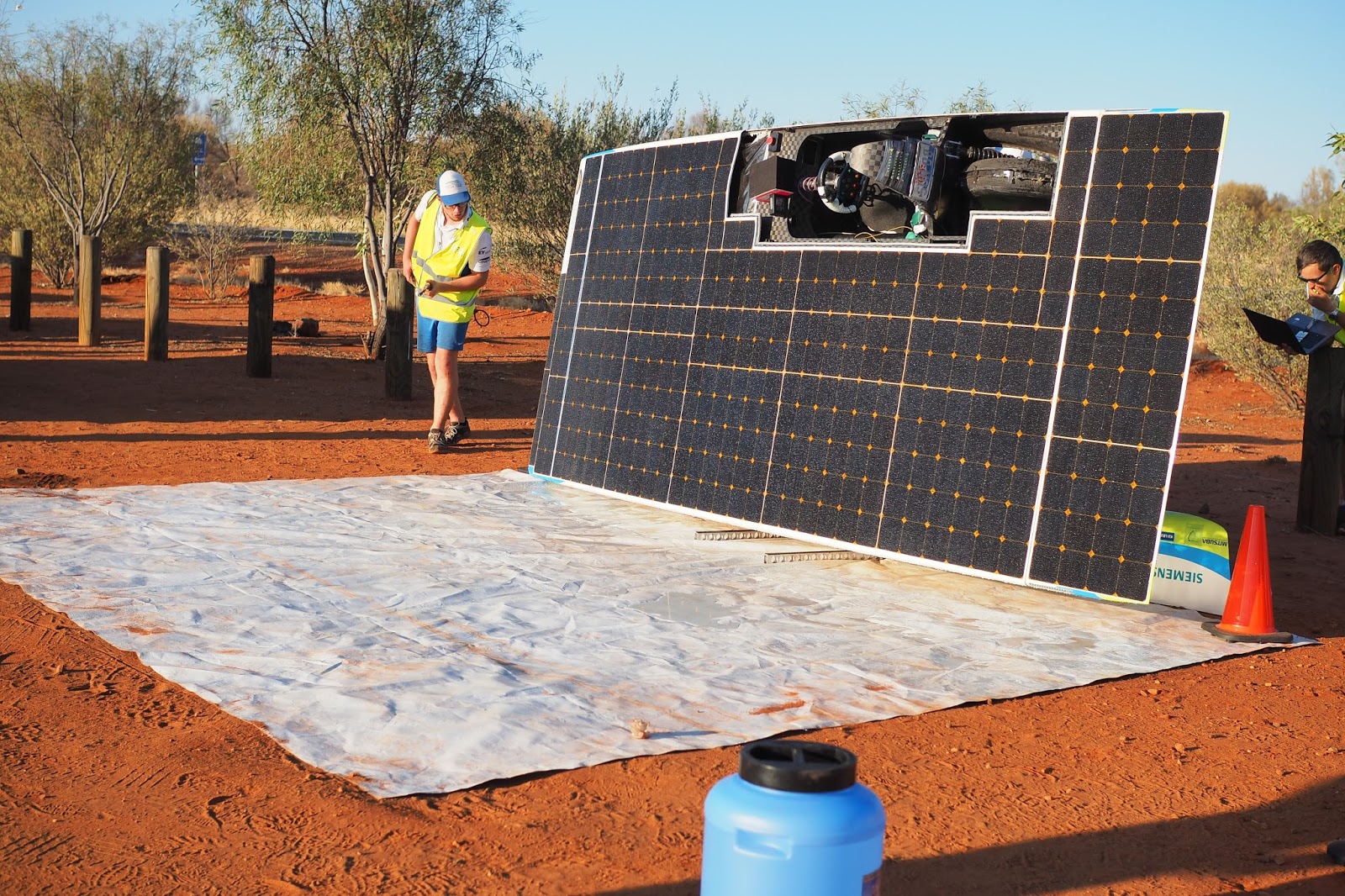
Note that the heading on reg 2.4 is not "Solar Array", it is "Solar Collector". The wording of 2.4.2 makes some implications, but 2.4.4 makes it extremely clear: concentrators such as reflectors or lenses are counted in the allowed aperture area of the solar collector. So no using lenses or mirrors to increase the effective aperture of your solar collector, as many teams have been trying for the past several races. And 3.18.3 explicitly bans the use of ground sheets to increase irradiance while statically charging.

Although the bounding box for the charging configuration is gone, reg 2.4.7 confirms that all devices used for solar charging must be carried within the solar car - including stands, supports, and cables.

An aside: I love the combination of larger bounding box + smaller array; it greatly frees up the aerodynamic design space. Teams are no longer constrained to a rectangular planform if they want to fit the full array! Expect to see wildly divergent design strategies from different teams at WSC in 2017.

Safety (2.10):

This new section mostly includes stuff that was found elsewhere in the 2015 regs - (2017) 2.10.1 corresponds with (2015) 2.23.1 and 2.23.3, while (2017) 2.10.3 corresponds with (2015) 3.1.7. But 2017's 2.10.2 is brand new, and requires each team to "engage a professional engineer, who must certify that the solar car is designed and constructed using sound engineering practice, and is roadworthy and fit for purpose." Certification from the PE is referred to specifically ("approved by the certifying engineer") in several other sections. This will be a big deal for some teams. Teams, if you're reading this, consult with a PE early! A good one is not just going to rubber-stamp your car after you've built it.

A quick scan through the document reveals that the battery protection system, driver/passenger occupant cell, safety belts, occupant ventilation/cooling, brakes, and tires all MUST be approved by the certifying engineer.

Occupant Cell (2.11):

This section is largely new - compare to section 2.4 in the 2015 regs. Impact survivability requirements (2.11.5) are both more numerous and more strict, and calculations must be certified by a PE. Notably, 2.11.4 specifies that no point on an occupant's helmet may lie within 50mm of the boundaries of the occupant cell. Although a forward roll hoop is not expressly required, I think this regulation will strongly push teams towards both a forward and rear roll hoop. The requirement for 50mm of of energy absorbing material on either side of the occupants in 2.11.6 is also an interesting addition, which appears to partially mimic reg 7.3.E.1 from the 2016 ASC regulations.

Stability (2.20):

This is an entirely new section, defining a figure-8 and slalom course that the cars must be able to complete. The courses and times are lifted straight out of the American Solar Challenge requirements - see section 7.9 of the ASC 2016 regs.

Control Stops (3.26):

There are some big changes to how control stops are operated. To summarize, the arriving driver, alone, may reconfigure the car from driving configuration to charging configuration before control stop timing starts. One the control stop clock has started, no team member may touch the car (although the car can reconfigure itself). After the control stop is over (30 minutes), the departing driver alone may reconfigure the car from charging configuration to driving configuration.

I think these rules are hilarious, and I love them. They're very clearly intended to eliminate the zoo at control stops, and be easy to inspect and enforce. It also forces teams to build simple and robust array starts that are quick and esay to assemble - that is, if they want to normalize the array at checkpoints. Bravo, WSC. 

However, I think WSC wrote some of these regs too narrowly and maybe inadvertently opened up some silly loopholes. The big one is 3.26.7: "Teams may not spray water on the solar collector during the 30 minutes of the control stop." At first blush, this looks reasonable, but to a devious cheaty solar car team member's mind, it's way too narrowly defined. I've already heard teams musing about spraying alcohol or other coolants on the array during control stops. I've also heard teams discussing "what constitutes 'spraying', anyway? What about squirting water on the array? Dribbling water on the array?"

I did a quick scan through the document to see if there's anything that would prevent teams from using coolants other than water. 3.18.3 states that "External devices intended to increase the irradiance on the solar collector must not be used at any time." but coolants aren't actually increasing the energy flux onto the array itself, like lenses or reflectors do, so I don't think this rules out other coolants. Similarly, 3.28.1 mentions that ambient temperature water may be sprayed onto the car from a hand-operated pump, but does not specify that this is the only coolant allowed, nor that this is the only allowed application method. This is a reversal of the wording in 2015, where reg 3.27.6 stated that ONLY coolant allowed would be ambient temperature water, ONLY applied by use of a hand-operated spray.

I think this is an error on WSC's part, and I'd expect a regs bulletin to be issued clarifying this at some point in the future.

Cruiser Class:

Running down Cruiser Class regs changes in one location:
  • 2.4.2: Cruiser Class is allowed 5m2 of silicon solar cells, and the same proportions of other cell chemistry as in Challenger. This is down from 6m2 in 2015.
  • 2.5.2: Total allowable battery mass is unrestricted (!!!) for Cruiser cars.
  • 3.13.5: Cruiser Class cars must complete dynamic scrutineering with all seats occupied.
  • 3.18.2: Cruiser Class cars may recharge from external sources at any time except during control stops. 
  • 3.27.10: If a Cruiser team elects to not charge from an external source overnight then all work on the solar car must cease and the car must be secured to the satisfaction of the observer, despite reg 2.5.16.
4.4 is where the meat of the Cruiser Class changes are detailed. The format of the Cruiser Class has changed significantly. For starters, the Cruiser race is now run over a fixed time period. All Cruisers must arrive in Adelaide between 11:00 and 14:00 on the 6th day of the race (4.4.1). No credit will be given for arriving before the target time window (4.4.5), and teams arriving after the target time window will not be ranked (4.4.6).

The Cruiser class will be run in a single stage - no forced overnight stop in Alice Springs.

The new scoring equation detailed in 4.4.3 is very interesting. One of the four factors from the 2013 and 2015 regs (elapsed time) is eliminated as detailed above, and the two remaining performance based factors - person-km and energy usage - have been rolled into a single "energy efficiency" factor. This is defined as person-km divided by energy usage; both factors calculated in the same way as in previous years. Energy efficiency is 80% of the score, and practicality is 20% - compare this to 18.87% for practicality in 2013, and 10% in 2015.

Generally speaking, I like the new format a lot. The fixed arrival time means that teams are all equally ready for practicality judging; no worrying about stragglers - and it'll be a good spectacle when they all parade in together. The new scoring equation results in a much more complex and non-linear design space, as carrying more people or using less grid energy has a multiplicative effect on the energy efficiency score. I suspect we'll see a lot of 4-seat cars, and although it's tough to fit more people than that and still stay within the load ratings of solar car tires, I'm very curious to see if anyone tries a 6+ seat car with very low rolling resistance "real car" tires like those found on the BMW i3.

The amount of margin to carry in the battery is also very important, because the cost of screwing up strategy is far higher in Cruiser class. In the Challenger class, if strategy is screwed up, oh well - the team may drop back a place or two, but they'll still finish close to where they were going to anyway. In Cruiser, if a team misjudges and has to charge up off the grid an extra time, it results a giant step-function on their score. There's also a lot of very tight risk vs reward calculations on how tight to cut the arrival window... Cruiser is a very complex optimization problem this year - moreso than in the past - and I'm kind of fascinated by it.

That said, I'm really disappointed in the solar array size for the Cruiser class. The reduction in array size is fine for the Challengers as they've been edging up in speed, but most of the Cruiser class really struggled to finish even with with 6m2. The reduction in array + emphasis on more passengers is going to make the Cruisers even more dependent on grid energy than they already were. Early rumors seemed to indicate that the Cruiser's arrays would be increased to 8m2 for 2017, which sounded a lot more reasonable to me.

I still don't like how vague and subjective the practicality judging is, and I especially don't like that it's an even larger part of the score than it was in the past two runnings of the Cruiser class, but I'm probably just yelling into the void about this.

Minor Changes:


Entry Fees (1.14):

Fees are up quite a bit across the board; roughly 30%.

Drones (1.28):

The regs note that all UAV flights must comply with relevant Australian regulations as well as be approved by the event organizer.

Dimensions (2.2):

Reg 2.2.3 is a little interesting - "The fully-laden solar car must be able to drive off a road with a 50 mm vertical edge drop without any part of the body touching the ground." See also reg 3.24.1 - "No team vehicle may stop on the road except in an emergency or when required by traffic conditions. Stopping on the road so that you can lift your car off the road is dangerous, and will attract a penalty determined by the Clerk of the Course." The second sentence there is new for 2017; I'm guessing there were some shenanigans with the catamaran cars scraping their bottoms on the shoulder drop-offs in 2015...

Reg 2.3.4 refers to future International Solarcar Federation (ISF) events and regulations, and requires Challenger cars to provide internal space for up to 2m2 of supplementary array, although that won't be utilized at WSC 2017. There's no mention of how this space will be measured, so I'm assuming this space will be left up to the teams to justify and this is a reg without teeth to back it up. That said, the mention of ISF is very interesting, and combined with the stability regs in 2.20 that are borrowed from ASC, perhaps we're seeing some subtle indications of closer collaboration between race organizers in the global solar car community. This is a very good thing!

Energy Storage (2.5):

No major changes; the allowed Challenger Class battery mass (2.5.1) for Li-Ion, LiPo, and LiFePO4 are all unchanged at 20kg, 20kg, and 40kg, respectively. LiS is a new addition, at 15kg. NiMH and Lead-Acid have been dropped from the main list (presumably due to few teams using them) although teams can still contact the organizers if they want to use them or other unlisted battery chemistry (2.5.2).

LiS appears very compelling at that allowable mass, although they are not in widespread commercial use yet so procurement may be harder.

Vehicle Identification (2.6):

The angles which one can see the license plate from are much more strictly specified in 2.6.2. This reg also defines a "flat vertical surface... at the rear of the solar car" to which the license plate will be mounted. This may be specifically disallowing putting the plate on the back of the roll cage inside the driver's canopy? 

Signage (2.7):

Largely the same. The front 600mm x 150mm area now has the clarification "...must not overlap with the solar collector. Part of the front signage area must be further forward than every part of the solar collector", which is likely in response to Twente's shenanigans in 2015.

Seats (2.12):

A stipulation has been added in 2.12.2 that seats must face less that 10 degrees off from the direction of travel.

Egress (2.15):

In addition to demonstrating un-assisted egress (2.15.1) during inspection, 2.15.4 states that during the event, occupants must exit the solar car without assistance. Does this mean that, even for the Challenger cars, the driver must get out before the team removes the top of the car? This probably won't be an issue with the smaller cars we'll be seeing this year (especially if they're still catamarans), but this is an interesting little addition.

Cooling and Hydration (2.16):

2.16.1 states that the driver ventilation and/or cooling system is one of the many things that must be approved by the certifying engineer, and 2.16.2 specifies that the driver must be provided with 2L of drinking water. Both of these were simply described as "must be adequate" in the 2015 regs (2.5.1).

Forward Vision (2.17):

This reg specifies that the driver must be able to read 75mm high letters in the forward vision, not just "be able to see" as stated in the 2015 regs (2.6.1). It also defines forward vision as 100 degrees right and left of the direction of travel, not simply "every forward angle" as in 2015.

Brakes (2.21):

There's a lot of new stuff here this year. As in past years, cars are required to have redundant brake systems. The reg this year (2.21.2) specifically states "The solar car must be equipped with independent primary and secondary mechanical braking systems, so that if the primary system fails the secondary system can still stop the solar car." However, 2.21.5 states that "the primary braking system must apply mechanical braking effort to all road wheels" (emphasis mine). So teams can't have one brake system act only on the front wheels and another act only on the rear wheels, as some teams have split their redundancy in the past.

Required deceleration remains the same as in previous years, although WSC has added another (lower) requirement (2.21.9) for the secondary brake system alone if the primary has failed.

WSC has expanded the parking brake requirement (2.21.10) to all entries; in 2015 only the Cruiser class needed a parking brake.

Tires (2.22):

The tread depth requirement from 2015 (2.11.3) has been eliminated. As I detailed in an old post, the tread depth regulation was introduced in 2009 but basically neutered in 2015, and I'm not surprised to see it gone this year. Tire technology has advanced a lot in the past decade, and the tires teams use will continue to be far better than the old ones, even with this regulation eliminated.

Reversing (2.23):

All solar cars must be able to be driven backwards, not just the Cruiser class as in 2015.

Lights (2.24):

Solar cars are now required to have side turn indicators, in addition to front and back. The requirement for UNECE or SAE/DOT compliant lights is expanded to all classes of solar cars, not just the Cruiser class as in 2015.

Horn (2.25):

There is now a required sound pressure level - 105 dB at 2m away from the horn.

Instrumentation (2.26):

Teams are now required to display a minimum of information to the solar car driver - speed, whether the turn signals or hazard flashers are operating, and any warnings from the battery protection system.

Automatic Functions (2.27):

It addition to requiring cruise control to turn off when the brakes are touched, any "automatic driving function" must deactivate on any manual input. This appears to be a preemptive regulation in case any teams implement self-driving functionality.

Electrical Safety (2.28):

2.28.10 requires a main battery fuse or circuit breaker, which shockingly appears to NOT have been required previously?

Safety Equipment (3.5):

Teams are now required to carry sand and a spade, in addition to a fire extinguisher. Similar to above, I'm a little shocked this wasn't required before - an ordinary fire extinguisher isn't doing to do shit when 20kg of lithium batteries ignite.

Energy Collection (3.18):

3.18.3 now very specifically mentions that ground sheets may not be used to increase irradiance on the array while charging, so presumably no more of this from teams will be tolerated.

Penalties (3.31):

The minimum penalty for Challenger class cars (3.31.2) is now 30 minutes, up from 10 minutes.

A new penalty policy for Cruiser class cars is detailed in 3.31.3. Rather than serving a time penalty, Cruisers will have penalties applied to their energy efficiency score.

It appears that only the Clerk of the Course can issue penalties in 2017, instead of Red-Shirt Officials as in the past.

WSC has adopted a "three strikes and you're out" policy with penalties (3.31.4).


TL;DR

Arrays are smaller, while allowed car sizes are bigger. I think this is a great thing, and will really shake up how teams design their cars. It's going to be an exciting time to be a solar car aerodynamicist!

The 2015 bounding box for the car while array standing is eliminated, but they've kept the 2013/2015 requirement that any and all equipment required for array standing must be carried within the car.

Control stop rules have been changed - all reconfiguring from driving to charging and back must be performed solely by the driver, and only before the control stop starts/after it ends. No touching the car - period - for the full 30 minute duration of the stop, including array spraying. The new setup and water-spraying constraints do not apply to end-of-day stops. This should be very easy for WSC to consistently enforce across the entire race, and hopefully quell complaints about checkpoint shenanigans.

LiS batteries are potentially compelling. The use of multijuntion GaAs arrays and especially thin-film GaAs arrays are potentially compelling. Hopefully we'll see a lot more variety of batteries and arrays, instead of nearly every team using Panasonic 18650 LiIon batteries and Sunpower silicon solar cells.

Big changes to the Cruiser Class - it's now an efficiency challenge over a fixed length of time, and the scoring dramatically emphasizes carrying more passengers. Practicality is also more important than it was in 2013 or 2015.

There are some subtle indications that WSC is working with the organizers of other solar car races to move towards more cross-compatible regulations, which I think is a very good thing.

Generally speaking, I think these regs move in a lot of good directions, and I'm excited to see what teams bring to Australia in 2017!